For healthcare, rehabilitation, military, veteran and caregiver-serving organizations
The patient has a discharge plan.
Is the caregiver ready to take over?
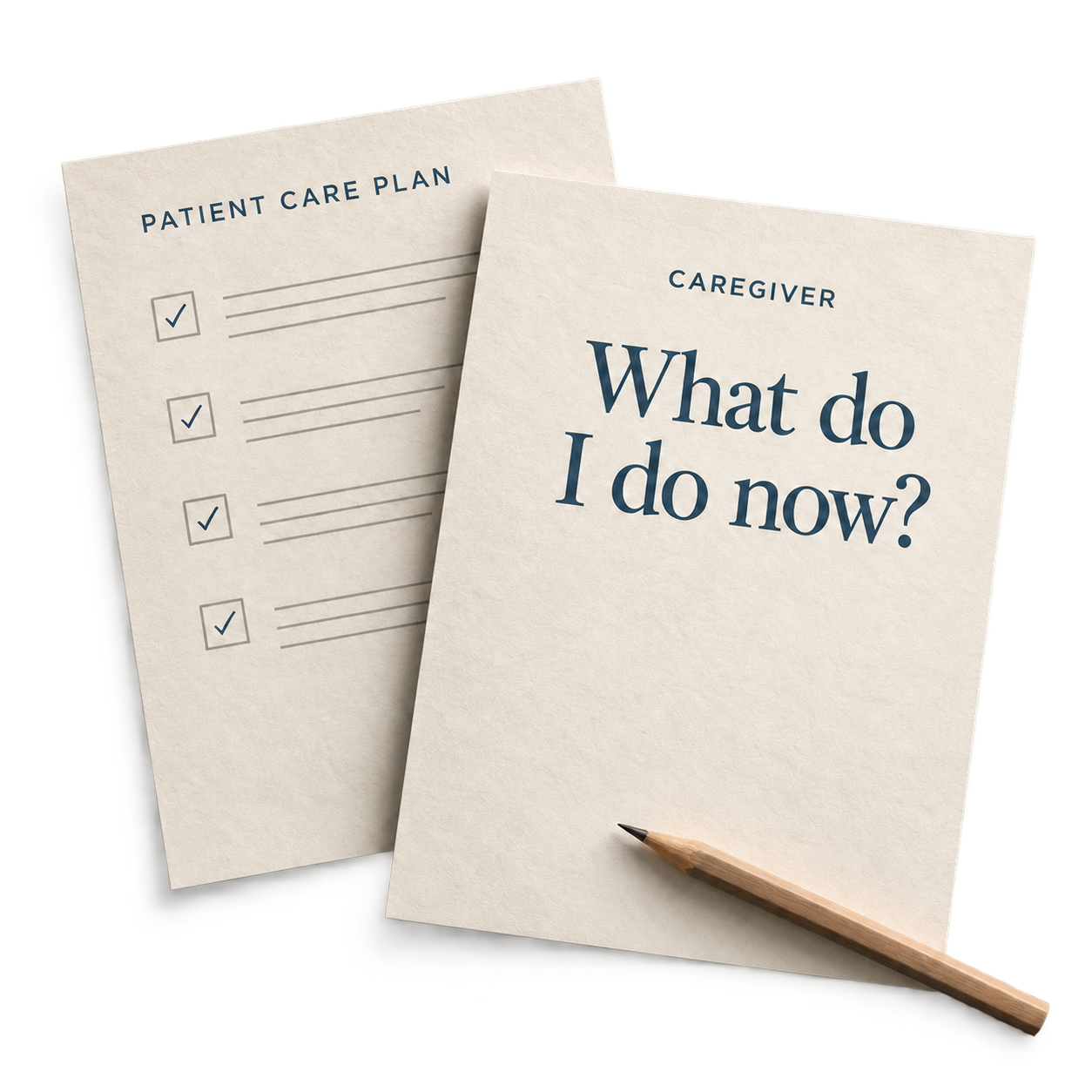
When care moves from a hospital, rehabilitation facility, or organized support setting into the home, families often become responsible for tasks and decisions they've never had to manage before. They may know what needs to happen next, but
Is your team confident caregivers understand the responsibilities they’re taking home?
Do staff have a clear way to uncover unanswered questions before discharge?
Can your team feel confident caregivers know where to turn when something doesn’t go as planned?
The Caregiver Candor Transition Program™ provides practical, non-clinical caregiver education that complements your existing discharge, transition, and family support processes.
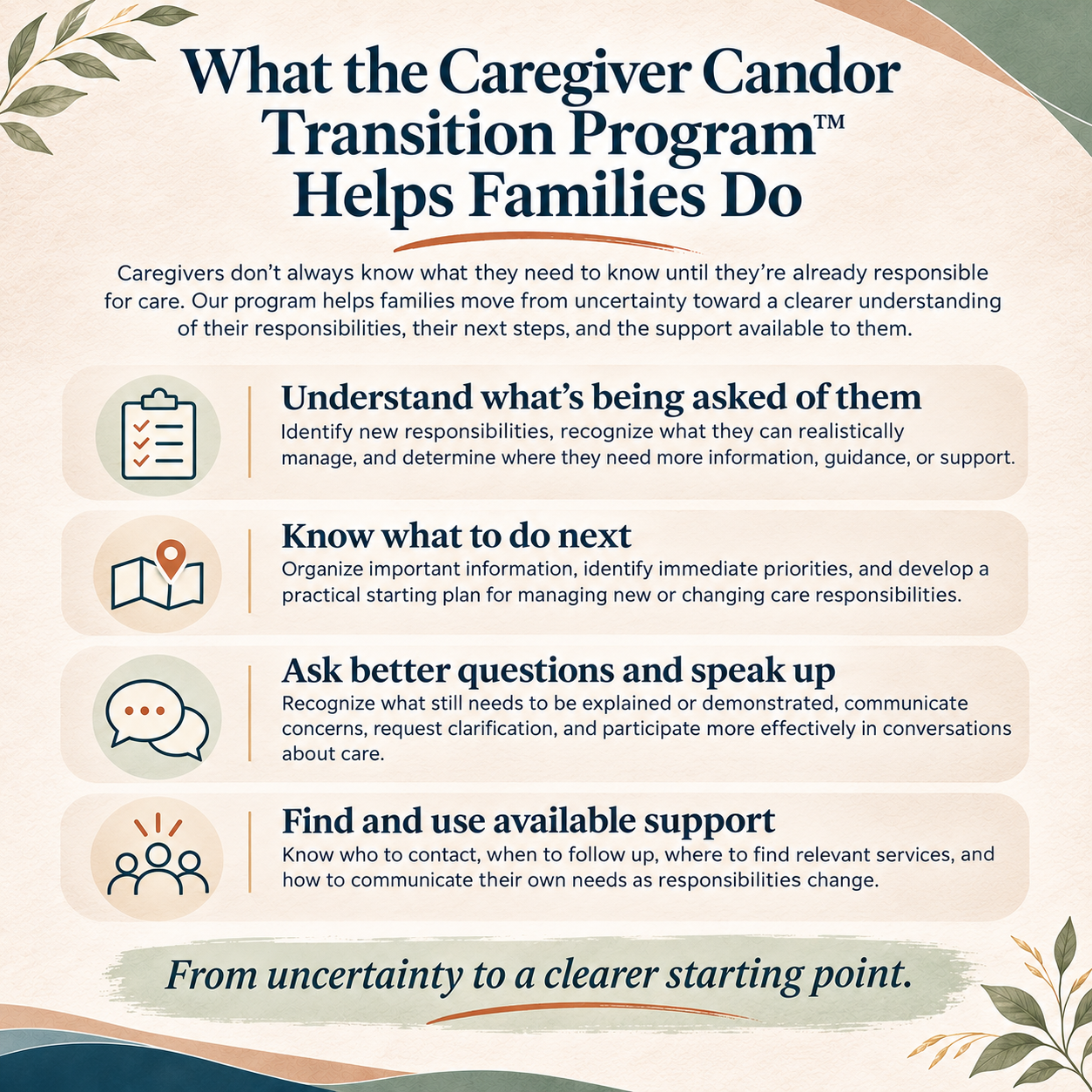
We help your team provide a consistent starting point for caregivers, clarifying responsibilities, surfacing unanswered questions, building skills to ask for help and communicate concerns, and connecting them with your existing support. This gives staff a shared foundation to build on, rather than starting from scratch with every family.
Designed to fit your existing workflow, not create another one.
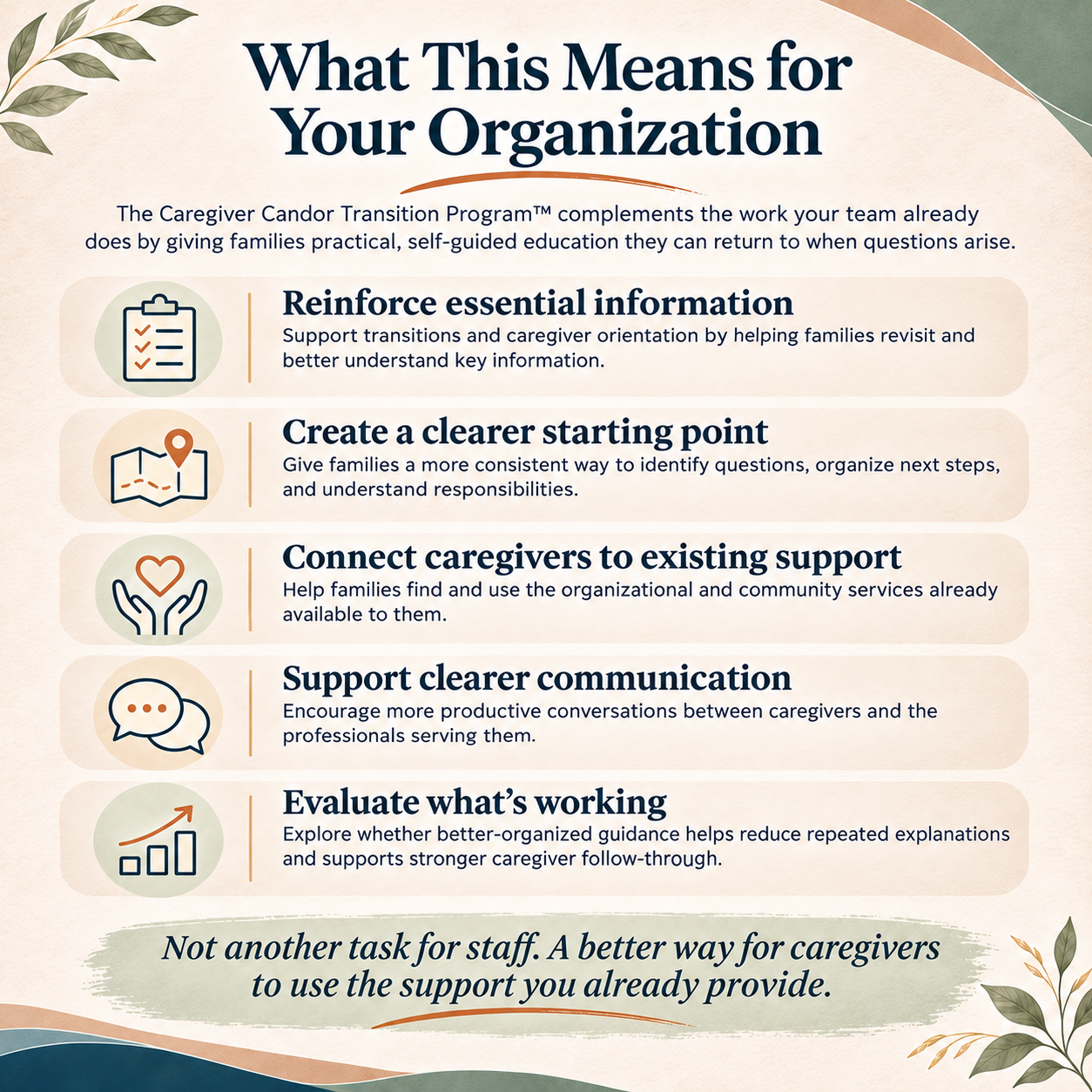
We tailor the program's materials and support pathways to your organization, provide simple guidance for staff to introduce them, and offer a structured pilot to gather caregiver feedback and evaluate how well the program works for the families you serve.
Most caregiver resources focus on helping people cope with caregiving.
We’re teaching people how to actually DO it.
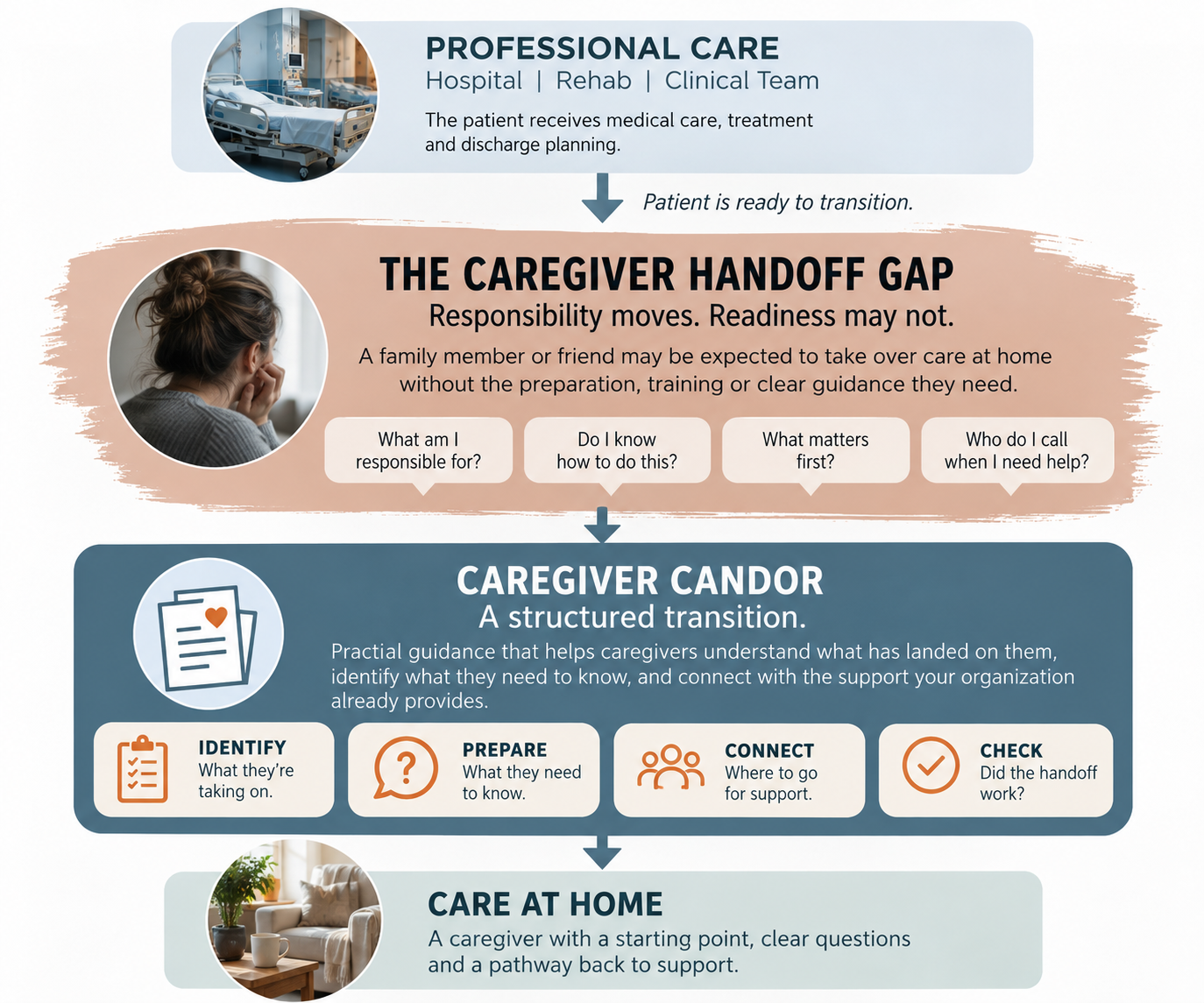
Discharge planning addresses a patient's clinical needs and the next stage of care. But when families return home, they're often responsible for coordinating appointments, managing daily routines, navigating unfamiliar services, and knowing when to ask for help.
A family member may leave with discharge instructions and still have questions about what they're expected to do, what needs to happen first, and who to contact when something doesn't go as planned.
The handoff shouldn't end with the paperwork.
The Caregiver Candor Transition Program helps organizations extend practical, non-clinical guidance into the transition gap, giving families a clearer starting point and a pathway back to the support available to them.
Knowing who is taking over care doesn't necessarily tell us whether caregivers understand what they're taking on.
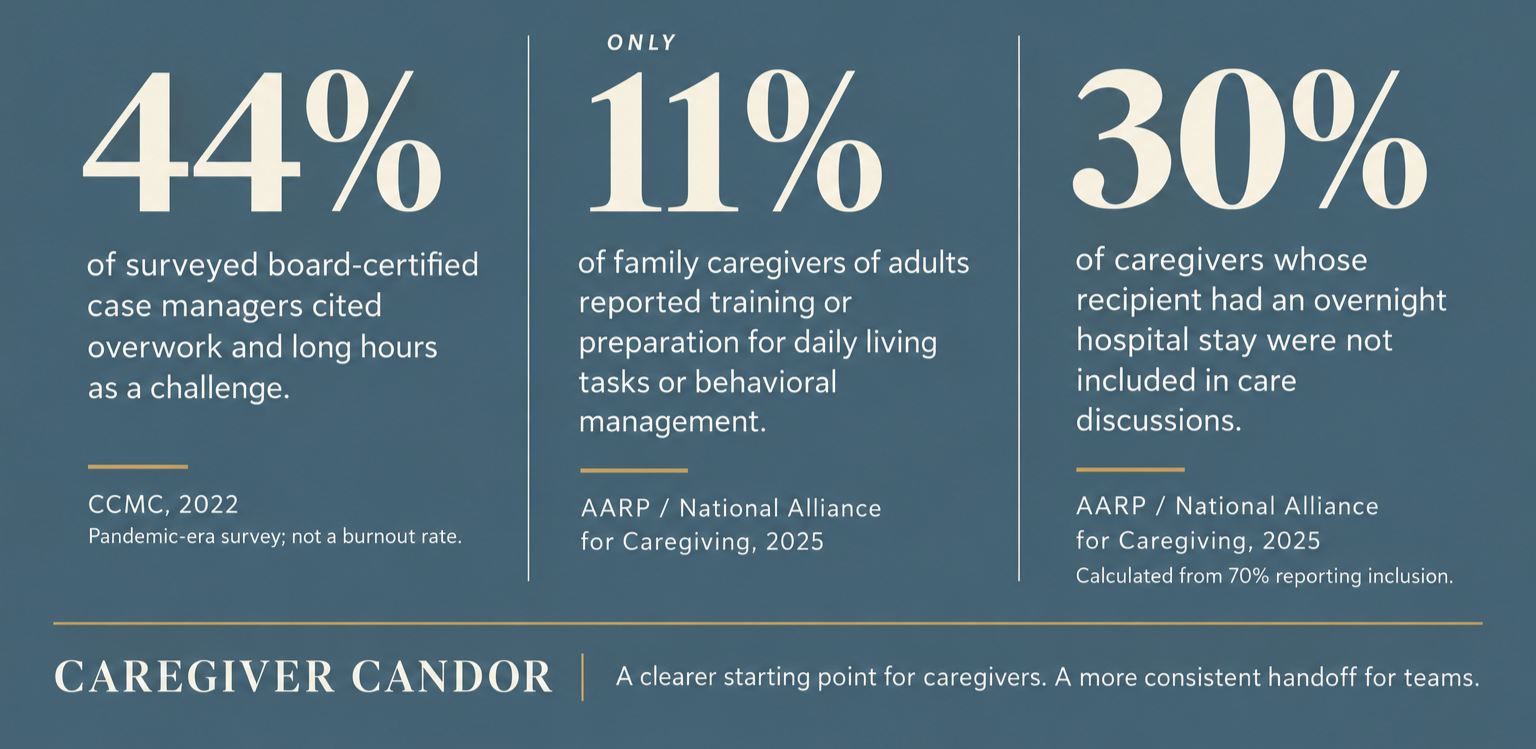
Caregiver preparation gaps overwhelm an already stretched workforce.
Healthcare and community support teams are managing significant demands on their time. At the same time, family caregivers may need more preparation, clearer guidance, and opportunities to ask questions before taking on new responsibilities. Research has identified gaps in caregiver training and involvement in care discussions, alongside substantial workload pressures reported by case managers.
These findings point to an important opportunity:
How can organizations strengthen caregiver preparation without adding another complicated process for staff to manage?
The answer doesn't always require creating more services. Sometimes it starts with helping caregivers better understand their responsibilities, recognize what they still need to know, and connect with the support that already exists.
The Solution: A practical Caregiver Transition Program™, built around your existing workflow.
The Caregiver Candor Transition Program is a structured, organization-tailored approach to helping family caregivers prepare for changing responsibilities. It supplements your existing discharge education, transition planning, or caregiver support services with practical, self-guided materials that caregivers can use to identify questions, organize their next steps, and find support.
Your organization continues providing its existing clinical education and services. Caregiver Candor helps families make better use of that information and support. The program is designed to be straightforward for staff to introduce and practical for caregivers to use, without requiring your team to build a new education program from scratch.
Begin with a focused Caregiver Transition Pilot.
You don't have to redesign your entire discharge process. Start small. Find out what works.
A focused pilot lets you test the program with one caregiver group at one transition point.
Start by identifying one transition where significant responsibility is moving from your team to a family caregiver and test a structured caregiver handoff alongside the process you already use.
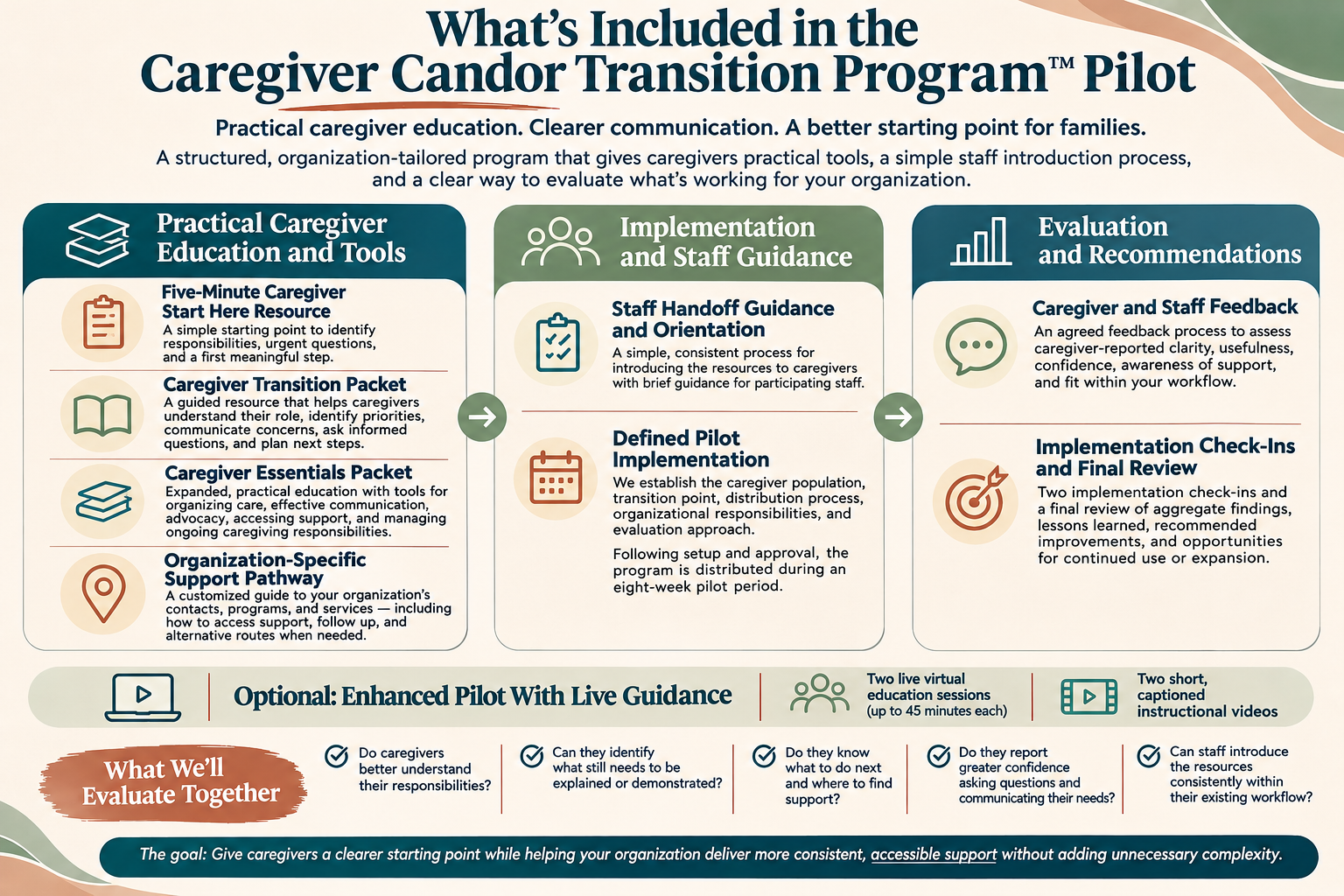
What's included in the Caregiver Transition Program™ pilot
Practical caregiver education. Stronger advocacy. Clearer communication. More confident next steps.
A Practical Program. A Straightforward Process.
Supporting caregivers shouldn't require your team to build another program from scratch. The Caregiver Candor Transition Program™ is designed to fit within your existing services and workflows. We provide the education, practical tools, and implementation guidance. Your organization helps us identify where the program fits and connects caregivers with the resources.
Here's How We Work Together
01
Identify The Right Starting Point
We begin with a conversation about the caregivers you serve, the challenges they encounter, and where additional guidance could make a difference.
Together, we select one caregiver population, transition point, or service pathway for the pilot.
02
Tailor the Program to Your Organization
We adapt the program materials to reflect your existing services, contacts, and support resources.
Your staff receive brief handoff guidance and an agreed process for introducing the materials to caregivers.
Caregiver Candor adapts the packet with your approved contacts, services and instructions for accessing help.
03
Implement the Eight-Week Pilot
Once materials and the workflow are approved, your team begins introducing the program to participating caregivers.
Caregivers use the resources independently, with access to the Caregiver Essentials Packet for additional education and practical tools.
We stay connected through two scheduled implementation check-ins to identify questions, address challenges, and gather initial feedback.
04
Evaluate What Worked
We gather caregiver and staff feedback to understand whether the resources were useful, helped families identify their next steps, and made available support easier to find.
We also examine how the program fit into your existing workflow, what worked well, and where improvements may be needed.
At the end of the pilot, we review the findings together and discuss recommendations for continued use, refinement, or expansion.
One starting point. A defined process. Useful information for deciding what comes next.
Different Organizations. A Shared Challenge.
Caregiving responsibilities don't change only when someone leaves a hospital. They can change after an injury, a new diagnosis, a decline in health, or when a family member gradually takes on more responsibilities at home. The Caregiver Candor Transition Program™ can be tailored to organizations helping families navigate these changes.
Hospitals and Rehabilitation Facilities
Support family caregivers as patients transition from clinical care to home. Our program complements existing discharge education by helping families identify responsibilities, organize unanswered questions, plan their next steps, and understand where to turn for continued support.
Area Agencies on Aging and Community Support Organizations
Help families navigate growing care responsibilities and connect with services that support them. We provide practical education and organization-specific support pathways that make it easier for caregivers to understand their role and access the programs and resources already available in their communities.
Veteran-Serving and Military-Family Organizations
Support families adjusting to the realities of caring for an injured, ill, or disabled service member or veteran. Our tools help caregivers recognize changing responsibilities, communicate their needs, advocate effectively, and navigate available veteran and family support services.
Care Coordination and Caregiver Support Programs
Extend your existing education and caregiver support efforts with consistent, self-guided resources. The program helps participating caregivers identify what they need to know, prepare for conversations, and take practical steps between interactions with your team.
Different settings. Different responsibilities.
The same need for clear information, practical preparation, and accessible support.
Could Caregiver Candor Help the Families You Serve?
You already have people, programs, and resources working to support caregivers. Caregiver Candor can help families better understand their responsibilities, recognize what they still need to know, and find their way to that support.
Let's explore whether the Caregiver Candor Transition Program™ could strengthen the caregiver education and support you're already providing. We'll start with your organization's needs, the caregivers you serve, and where a practical pilot might make sense.
Get In Touch
If you're interested in working with us, complete the form with a few details about your program/project. We'll review your message and get back to you within 48 hours.