
What family caregivers need to clarify before leaving an appointment, discharge meeting, or conversation about what happens next.
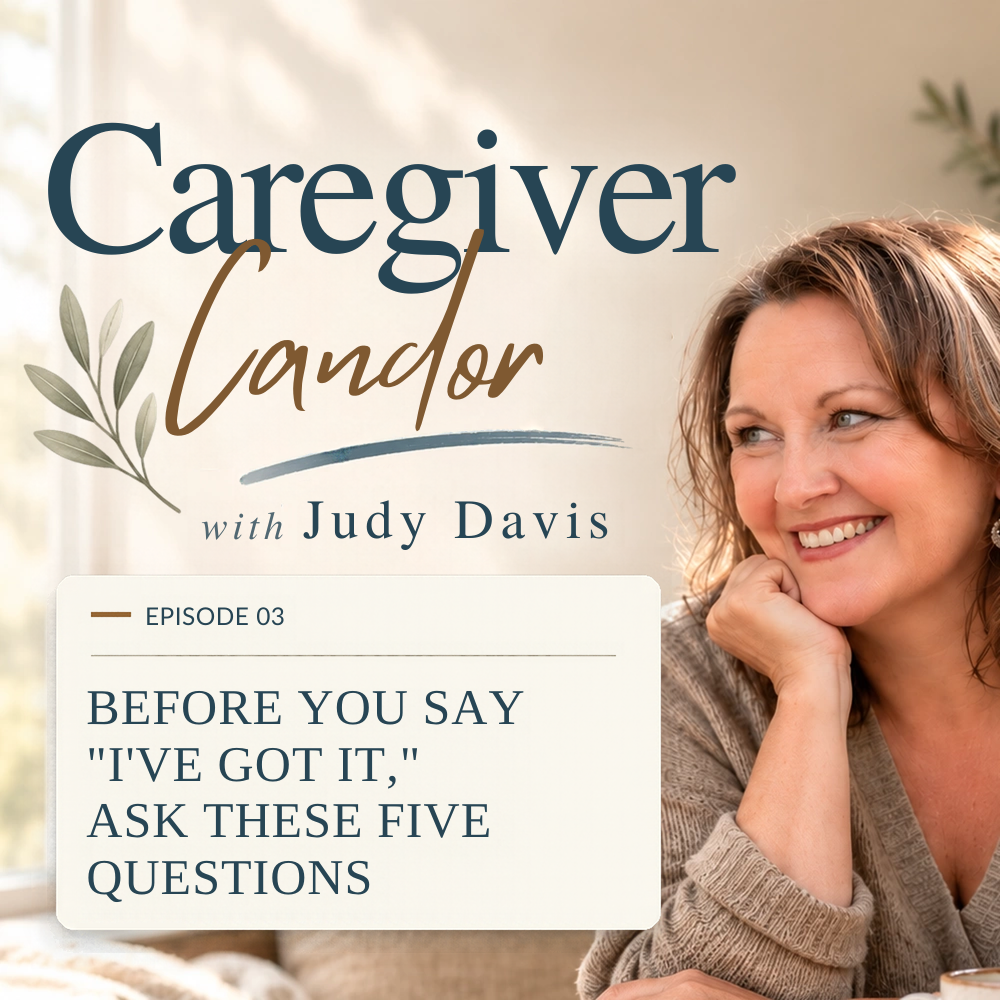
Find us wherever you listen to podcasts. Search Caregiver Candor. 🎧
Inside This Episode
Have you ever said, “I’ve got it,” when you weren’t entirely sure what “it” was? Someone explained something quickly. Everyone seemed busy. You had questions, but you couldn’t quite put them into words. So you nodded. Then you got home, looked at the paperwork, and thought, Wait. What exactly did I agree to?
Caregivers are often the people expected to turn instructions into everyday life. Arrange the ride. Schedule the appointment. Figure out the equipment. Make the plan work around a job, a household, and everything else that didn’t conveniently disappear when someone needed care.
That’s a lot of responsibility to accept with a simple nod. Before you say, “I’ve got it,” you deserve to understand what you’re being asked to carry.
The medical team had a plan. Our family still needed one.
After my husband Geoff was critically injured in an Army explosion, we learned he would be transferred from Washington state to a military medical facility in San Antonio. The flight was leaving in four hours. Four hours to figure out what would happen to our house, our pets, our business, and the life we had in Washington. My adult children were there, thankfully. We decided I would stay behind to handle things at home, and my daughter would travel with Geoff.
Then we learned there wouldn’t be a nurse accompanying them on the medical flight. There was a bag of medications and instructions to follow those instructions. The team had a plan for getting Geoff to the next facility. Our family had to figure out how to carry out the responsibilities being placed on us.
Those were two different plans.
Looking back, I can name questions I wish we’d had the time and presence of mind to ask. What exactly was my daughter expected to do? Who was responsible for the medications during travel? Who could she contact if something changed?
When your world has just been turned upside down, you don’t always know what you don’t know. That’s why having a few questions ready can matter so much.
1. What exactly am I being asked to do?
“What does the care plan say?” and “What am I personally expected to handle?” are different questions.
“Make sure she gets to her appointments” sounds manageable until you discover there are three appointments a week, she needs help getting into the car, and you work full time.
“Keep an eye on him” sounds simple until you realize nobody explained what you’re watching for.
Ask for specifics.
Words you can use:
“Can we go through what I will need to do, how often, and what help I’ll need?”
Ask which responsibilities require professional support, training, or equipment. If you cannot safely manage a task, that needs to be part of the conversation.
Willingness doesn’t automatically give you the skills, time, or physical ability to do everything a plan requires.
2. Can you show me, then watch me do it?
Watching someone do something can make it look surprisingly easy.
Until it’s your turn.
A quick explanation may leave you familiar with a task without leaving you able to perform it safely.
For hands-on responsibilities, ask the appropriate professional to demonstrate and, when appropriate, observe you trying it.
Words you can use:
“I want to be sure I can do this safely. Can you show me, then check that I’ve understood?”
For medication questions, ask a qualified clinician or pharmacist to walk through the current, verified instructions and explain what changed.
And if you still cannot safely do what’s being asked, say so:
“I understand what needs to happen. I’m not yet able to do it safely. What’s the alternative?”
You don’t need to promise your way past a limitation.
3. What would tell me something is wrong?
“Watch for changes” leaves a lot of room for guessing.
Which changes? What would they look like? What are you supposed to do when you notice one?
The professionals responsible for your person’s care need to provide those specific instructions, including what requires a call, urgent attention, or emergency help.
Words you can use:
“Which changes should I watch for, and what should I do if I see one?”
Then ask:
“If this happens when the office is closed, what is the next step?”
If an explanation includes a word you don’t understand, stop there.
“Can you explain what that would look like at home?” is a perfectly reasonable question. You shouldn’t have to translate unfamiliar terminology while you’re already worried.
4. Who owns the next step?
“Someone will call you.”
Lovely. Who is someone?
Is a referral being sent? Is equipment being ordered? Is an approval still pending? Are you supposed to make a call first?
A plan can stall while everyone assumes somebody else is handling it.
Words you can use:
“Who is responsible for the next step, when should it happen, and who do I contact if it doesn’t?”
Write down the name or department, contact information, and expected timeframe.
You already have enough to do without becoming a detective just to find out whether the next step has started.
5. What if this plan doesn’t work in real life?
Care plans come home to actual households.
Households with jobs, stairs, transportation problems, financial limits, and people who need sleep.
If a plan assumes you’re available all day and you aren’t, that matters. If a task takes two people and there is only one of you, that matters too.
Words you can use:
“I want this to work. Here’s what I can realistically do. What other options can we consider?”
Be specific about the gap. Include the wishes and preferences of the person receiving care as you work through the options together.
Your capacity belongs in this conversation. A limitation that goes unspoken still exists when you get home.
The Truth in Between: “Yes” is not proof of readiness.
Sometimes a caregiver’s yes means, “I understand.”
Sometimes it means, “I’m afraid to ask another question.”
Sometimes it means, “Everyone is looking at me, and I don’t know what else to say.”
And sometimes it means, “I love this person, and I don’t see another option.”
Those are very different kinds of yes.
Caregivers deserve the opportunity to explain what they understand, what they still need to learn, and what they cannot realistically manage.
And professionals have a role in making those answers easier to say aloud. One useful place to start:
“What part of this plan will be hardest to carry out once you’re home?”
Not every barrier can be solved in one conversation. But an unspoken barrier is awfully easy to mistake for agreement.
Your Caregiver Move: The two-minute read-back
Before your next appointment, meeting, or phone call ends, say:
“Let me make sure I’ve got this right.”
Then finish these three sentences:
“My part is…” Explain what you’re expected to do, including when and how often.
“Your part is…” Confirm who is handling the next action and when to expect it.
“If something changes, I’ll…” Repeat the contact information and response instructions the care team provided.
If you can’t finish a sentence clearly, ask for clarification while you’re still in the conversation.
You don’t have to memorize all five questions. Start with the one that addresses your biggest uncertainty.
You can love someone deeply and still need someone to slow down, explain the plan, or help make it workable.
The person you’re caring for matters. And so does the person being asked to carry out the care.
Listen to the full conversation
For the full conversation, head to your favorite Podcast Streaming Platform and listen to Caregiver Candor Podcast Episode 3 “Before You Say ‘I’ve Got It,’ Ask These Five Questions.”
Listen on Podbean Listen on Apple Podcast Listen on Spotify
Put it into practice
Before your next care conversation, save these five questions to your phone. Ask the one you most need answered. Then say: “Let me make sure I’ve got this right.”
_____
If this episode put words to something you’ve been carrying, give it a like and share it with someone who needs to hear it. Follow Caregiver Candor wherever you listen so the next honest conversation is there when you need it.
And remember, you don’t have to figure all of this out alone. Our resources, social media feeds and the blog are full of practical tools, honest conversations, and the info you need to help you care for someone without disappearing in the process.